

What Do Hyundai Dashboard Warning Lights Mean?
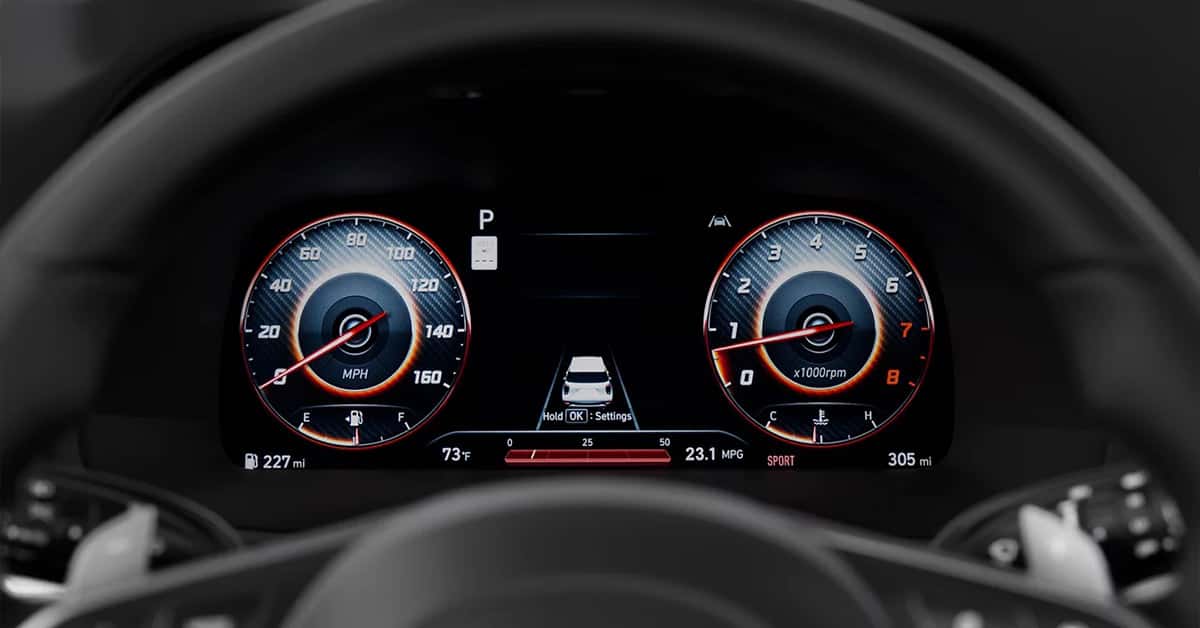
Every time you turn the key or press the start button in a model like the 2026 Hyundai Tucson, the instrument cluster performs a brief self-check. This sequence illuminates nearly every icon on the dashboard for a few seconds, confirming that the bulbs and diagnostic circuits are functioning correctly. If a light remains on after the engine has started, or if it flickers on while you are navigating the palm-lined streets of Delray Beach, it indicates that a specific system requires professional attention. Our team recommends checking the owner’s manual immediately to identify the symbol, as ignoring these alerts can lead to more extensive mechanical repairs.
The modern Hyundai instrument cluster is a sophisticated hub that monitors everything from engine oil pressure to the SmartSense driver-assist suite. In coastal environments where high humidity and salt air can eventually impact sensor longevity, staying proactive with these alerts is essential for long-term vehicle health. If you notice a persistent light, you can easily find our Delray Beach service center located right on Ne 6th Ave for a comprehensive diagnostic scan.
Deciphering the Color Code of Hyundai Diagnostic Indicators
Hyundai utilizes a universal color-coded system to help drivers instantly gauge the severity of a dashboard alert. Red lights are the most critical, signifying a serious malfunction or a safety hazard that typically requires you to stop the vehicle immediately to prevent engine damage or a collision. Yellow or amber lights serve as cautionary signals, indicating that a system—such as the TPMS or the emissions control—needs to be inspected soon, though the vehicle is usually still drivable for a short distance.
Green and blue lights are generally informational status indicators rather than warnings. For instance, a green icon might show that your turn signals are active or that the Forward Collision Avoidance Assistance system is engaged. A blue icon, such as the coolant temperature light, often appears when the engine has not yet reached its optimal operating temperature, a common sight during the first few minutes of a morning commute. When a yellow or red light indicates a hardware failure, you can order genuine Hyundai parts through our department to ensure your vehicle is restored using components designed specifically for your model’s tolerances.
Proper maintenance of these systems is backed by the New Vehicle Limited Warranty, which covers most components for 5 years / 60,000 miles. Understanding that a yellow light is an invitation to schedule maintenance rather than an emergency helps prevent the “cascading” effect, where a minor sensor issue eventually puts undue stress on major mechanical parts like the 2.5L I4 engine found in the 2026 Santa Fe.
Critical Red Indicators You Must Never Ignore on the Road
A red warning light appearing while you are driving is a signal to pull over to a safe location as soon as traffic permits. One of the most urgent icons is the Engine Oil Pressure warning, which looks like a dripping oil can. If this stays lit, it means the engine is not receiving proper lubrication, and continuing to drive could result in total engine failure within minutes. Similarly, the Brake warning light (a circle with an exclamation point or the word “BRAKE”) indicates either that the parking brake is engaged or that your brake fluid is dangerously low.
The Battery/Charging System light, shaped like a car battery, suggests a malfunction with the alternator or the electrical system. In the high-heat climate of South Florida, batteries and alternators face significant stress, and a failure here means the vehicle will eventually lose all electrical power, including headlights and power steering. If you experience a breakdown due to these critical systems, you should contact Hyundai Roadside Assistance: 800-243-7761, which is included for 60 months / unlimited miles on most new models.
Our technicians are trained to handle these high-priority repairs with precision, and you can meet our service team to learn more about the specialized equipment we use for emergency diagnostics. We prioritize these safety-critical issues to get you back on the road safely. Whether it is a cooling system failure or a deployment error in the SRS airbag system, red lights represent a “no-drive” scenario until a professional can clear the vehicle for service.
Common Yellow Warning Symbols and Safe Driving Protocols
Yellow or amber lights are the most frequent alerts drivers encounter, with the Check Engine Light (CEL) being the most recognizable. A steady yellow CEL often relates to the emissions system, such as a loose fuel cap or a failing oxygen sensor. However, if the Check Engine Light begins to flash, this indicates a severe engine misfire that can rapidly destroy the catalytic converter. In this case, you should reduce your speed and seek service immediately to avoid a four-figure repair bill.
The Tire Pressure Monitoring System (TPMS) light is another common yellow indicator. It typically looks like a horseshoe with an exclamation point. In South Florida, we find that sudden rainstorms or minor temperature shifts can cause air pressure to fluctuate enough to trigger this sensor. If the light is on, one or more tires are significantly underinflated, which compromises fuel economy and handling. Other common yellow lights include:
- ABS (Anti-lock Braking System): Indicates the computer-assisted braking is disabled, though standard mechanical braking still works.
- ESC (Electronic Stability Control): Often flickers when the system is actively helping you maintain traction on slick roads.
- SRS (Supplemental Restraint System): Signals a fault in the airbag system that may prevent deployment during an accident.
Maintaining these systems is part of the standard ownership cycle for a 2026 Hyundai Elantra, which utilizes a 2.0L I4 engine paired with a CVT. While yellow lights do not always require a tow truck, they are “active” faults that will cause the vehicle to fail an emissions test and may lead to reduced performance or safety.
Electric Vehicle Alerts and the Unique Hyundai Turtle Icon
Owners of Hyundai electric vehicles (EVs) have a unique set of dashboard icons tailored to battery health and power management. The most distinct of these is the “Turtle” icon, which officially represents the Power Limited Mode. This light appears when the vehicle’s computer restricts performance to protect the high-voltage battery. This usually happens when the state of charge is extremely low, or if the battery thermal management system detects that the cells are overheating due to sustained high-speed driving in extreme heat.
When the Turtle icon is illuminated, you will notice a significant decrease in acceleration and top speed. This is a failsafe designed to help you reach the nearest charging station or a safe parking spot without completely depleting the battery or causing permanent cell damage. If this light appears alongside a red battery warning, it indicates a more serious electrical fault that requires a diagnostic check of the inverter or the drive motor.
EV owners should also watch for the “Ready” indicator, which is a green car with a double-headed arrow. Because electric motors are silent, this light is the only way to know the vehicle is powered on and capable of moving. If this light does not appear when you press the start button, there may be an issue with the 12V starter battery or the high-voltage interlock system.
Troubleshooting Multiple Simultaneous Warning Lights and System Cascades**
It is not uncommon for a single component failure to trigger a “cascade” of multiple warning lights at once. For example, a faulty wheel speed sensor can simultaneously disable the ABS, the Electronic Stability Control, and even the cruise control system. This happens because these modern safety features all rely on the same data stream to function. When the computer loses that data, it shuts down every related system as a precaution, turning your dashboard into a “Christmas tree” of yellow and red icons.
Commuters driving from Boca Raton toward the shopping districts at Mizner Park often rely heavily on these integrated systems for stop-and-go safety. If you see multiple lights appear after a heavy rainstorm or a particularly deep puddle, it may be a sign of a moisture-compromised electrical connector or a failing battery. Modern Hyundai vehicles are highly sensitive to voltage drops; a battery that is starting to fail can cause the computer to throw “ghost” codes across various modules.
If several lights appear at once, the best protocol is to restart the vehicle once to see if the system resets. If the lights persist, a professional diagnostic is necessary. Our technicians use specialized software to look at the “freeze frame” data, which tells us exactly what the vehicle was doing the moment the lights were triggered, allowing us to pinpoint the root cause rather than just replacing parts blindly.
Utilizing In-Car Digital Manuals and Diagnostic Support at Delray Hyundai
Newer models, including the 2026 Santa Fe with its eight-speed torque-converter automatic, often feature an integrated e-Manual accessible directly through the infotainment screen. By navigating to the “Apps” or “Setup” menu, you can browse a digital library of warning light meanings and recommended driver actions. This is an excellent first resource when a new icon appears and you are away from home. Some systems even allow you to scan a QR code on the dash with your smartphone to pull up the specific manual page for that alert.
While the in-car manual provides the “what,” our service department provides the “how” for getting the issue resolved. We recommend keeping a record of when the light appeared and any changes in vehicle behavior, such as vibrations or unusual noises. This information helps our team move faster during the diagnostic process. For those who prefer to drop by for a quick inspection, you can find our service entrance on Ne 6th Ave.
If you are currently looking at a warning light and aren’t sure if it is safe to drive, don’t guess. You can reach our service advisors directly at 561-462-1991 to discuss the symptoms. We are here to ensure your Hyundai remains as reliable as the day you drove it off the lot, providing the expert care required for today’s advanced automotive technology.
Quick Answers About Hyundai Dashboard Alerts
Q: What type of OBD-II scanner do I need to read Hyundai ABS or airbag codes?
A: Most basic, low-cost code readers only access the Engine Control Unit (ECU) for emissions-related codes. To read ABS or SRS (airbag) codes, you typically need a mid-range diagnostic tool that supports manufacturer-specific modules. Our service center uses professional-grade scanners that can communicate with every computer in the vehicle, including the body control and transmission modules.
Q: Does a blue coolant temperature icon mean there is a problem?
A: No, a blue coolant icon simply indicates that the engine has not yet reached its normal operating temperature. You should avoid heavy acceleration or high-speed driving until the light turns off. If the light is red, however, that indicates the engine is overheating, and you must stop the vehicle immediately to prevent permanent damage.
Q: Why does my TPMS light come on even if my tires look full?
A: The TPMS is highly sensitive and can be triggered by a pressure drop of just a few pounds. In the fluctuating humidity of South Florida, air density changes can cause the light to illuminate. Additionally, as tires age, the sensors’ internal batteries can fail, which may require a sensor replacement rather than just more air.
Q: My 2026 Santa Fe has a new transmission; does it have different warning lights?
A: While the 2026 Santa Fe now uses an eight-speed torque-converter automatic, the warning icons for transmission temperature and gear selection remain standard. If you see a yellow gear icon or a message stating “Transmission Temperature is High,” it is important to stop and allow the fluid to cool, as the torque converter generates heat differently than the previous dual-clutch units.
Q: What should be included in a Hyundai roadside assistance kit?
A: A proper kit should include a tire pressure gauge, jumper cables, a flashlight, and basic hand tools. While Hyundai offers a Roadside Assistance Kit (PIO) as an optional accessory, our parts department can help you assemble a custom kit that includes items specific to Florida driving, such as extra coolant and a high-quality reflective triangle for nighttime safety.
0 comment(s) so far on What Do Hyundai Dashboard Warning Lights Mean?